

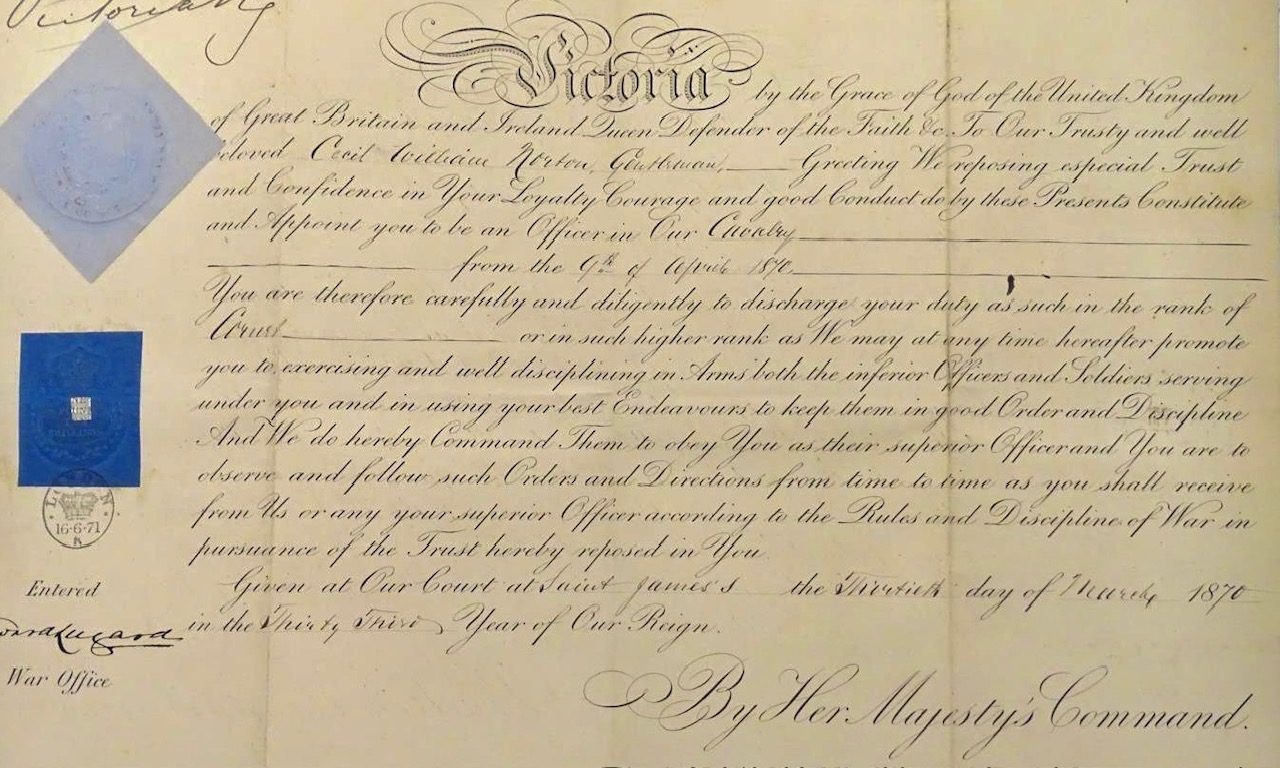
Until 1871, British army officers were recruited through a system of patronage and purchase, allowing wealthy young men, often from aristocratic or landed families, to buy an officer’s commission. Typically, most young gentlemen joining an infantry regiment as an Ensign, the lowest ranked officer, would buy their commission “by purchase.” In 1867 the cost of an Ensigncy in an infantry regiment was £450, equivalent to approximately £65,000 today.
One of an Ensign’s primary responsibilities was to carry the regiment’s colours (flags) during battle, a role of great symbolic and tactical importance. A regiments colours served as rallying points and were fiercely defended, making the Ensign’s position both honourable and perilous.
Ensigns were expected to lead by example, maintain discipline, and assist in training soldiers. They often commanded small detachments and were responsible for ensuring orders from senior officers were executed properly. Though inexperienced, Ensigns were groomed for higher command and were expected to learn military tactics, drill procedures, and regimental administration.
Their social standing was as important as their military competence, especially in an era when leadership was closely tied to class. In peacetime, they participated in garrison duties, parades, and social functions, reinforcing the regiment’s presence and prestige.
Overall, the Ensign’s role combined military duty, personal bravery, and social expectation, serving as a stepping stone to more senior ranks within the British Army’s rigid hierarchy.
An officer commissioned or promoted “without purchase” meant that the officer did not have to pay the purchase fee required by the purchase-system for that rank. Unpaid positions usually occurred when a vacancy arose through death, promotion, expansion, or where family connections and influential backers supported the officer’s appointment.
The 83rd (County of Dublin) Regiment of Foot had been established in 1793 during the French Revolutionary Wars. Raised to serve as part of Britain’s efforts against Revolutionary France, it initially operated in the West Indies and Ireland. The regiment was involved in several key engagements, including the French campaigns in Egypt and the Peninsula War (1808-1814). During the 19th Century the regiment was garrisoned at various colonies throughout the world, including Ceylon, Canada, Gibraltar, and India, while maintaining a significant presence in Ireland. By the mid-19th Century, it had become part of the British Army’s regular forces.
In 1862, the 83rd (County of Dublin) Regiment of Foot had returned from India and spent the next four years garrisoned at various locations throughout England. In January 1866, the regiment embarked at Liverpool and returned to Ireland, where it spent the next 14 months.
Towards the end of 1866, orders were received by the 83rd Regiment to make themselves ready for transportation to their next overseas posting at Gibraltar in the Mediterranean.
In March 1867, the regimental depot companies of the 83rd Regiment were moved to Colchester, England, while in April the rest of the regiment embarked at Kingstown, Ireland, and were conveyed by the troopship “Himalaya” to Gibraltar. Relieving the 86th (Royal County Down) Regiment in the Casemate Barracks, the 83rd Regiment would spend the next 3 years garrisoned at Gibraltar.
During 1867, the 83rd Regiment recruited nine new Ensigns, filling vacancies created by promotions, retirements, and one death in service. Those nine gentlemen were:
- Henry Warren Walker by purchase 22nd January
- Thomas Perry Powell by purchase 9th March
- William Stewart without purchase 17th April
- William Cooke-Collis by purchase 18th April
- Thomas Frederick Gibbs by purchase 19th April
- Arthur Vivian Henry Brookes by purchase 20th April
- Martin Oranmore Kirwan by purchase 8th June
- Henry Cooke Bond by purchase 4th September
- William Frederick Marriott by purchase 25th September
To see the faces behind the names and to hear about their life stories, click here
Researched and written by Gary Hynard 2025