

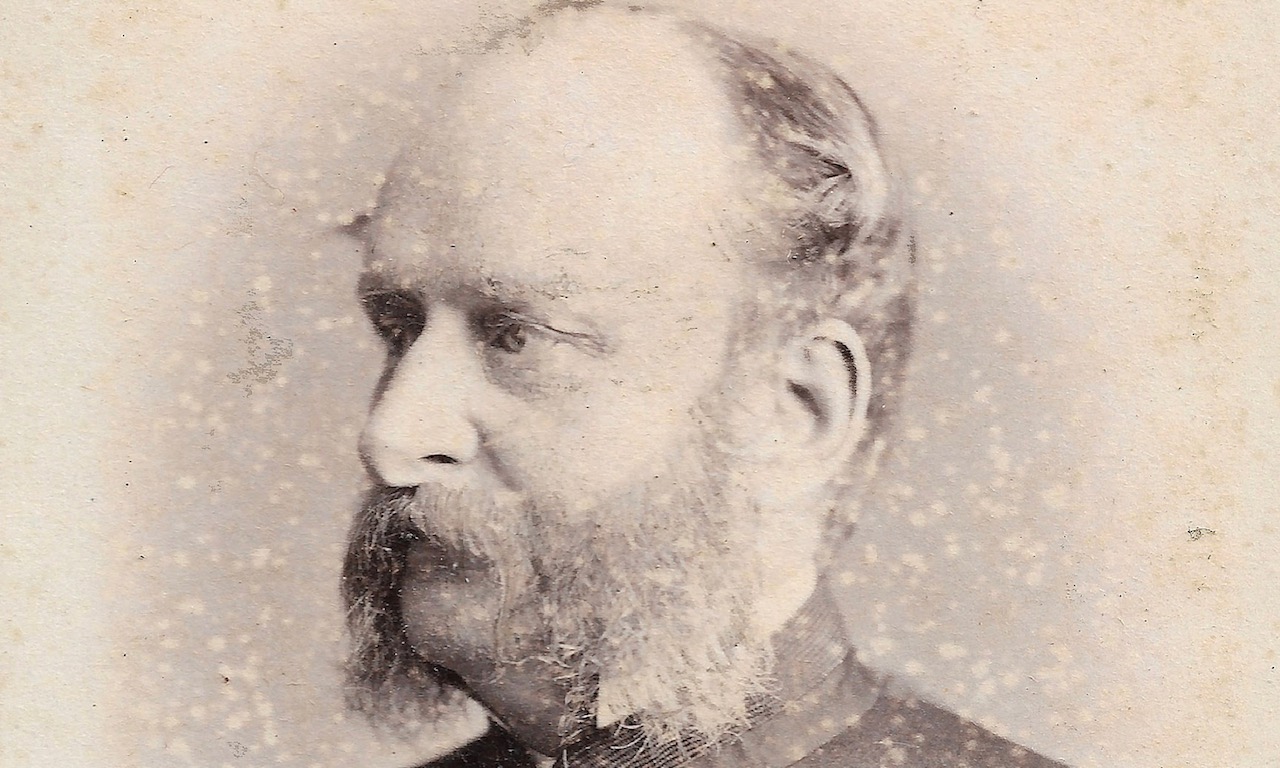
Corps of Army Schoolmasters – 103rd Royal Bombay Fusiliers – Persia Expedition 1857
97th (The Earl of Ulsters) Regiment of Foot – 83rd (County of Dublin) Regiment of Foot
Born 2nd September 1825 at Westminster, London, the son of Thomas Scrivener 1780-1831, and his wife Mary Scrivener (nee Shepperson) 1790-1852.
After completing his formal education, Frederick got a job training to be a surveyor. By the end of 1846, at age 21, Frederick had qualified and was working in London.
In 1847, the army opened a new school, the Normal School at the Royal Military Asylum, Chelsea. The new school’s purpose was to train prospective army teachers, who when qualified would join the Corps of Army Schoolmasters, which had been established in 1846. The role of the Corps was to educate soldiers and their children, teaching them basic reading, writing, and arithmetic skills.
Of the 24 civilian students who began the first course to be at the Normal School, only 13 completed it satisfactorily. The first of the 13 students to complete their training at the school, was a former London surveyor, Frederick Scrivener, who enlisted with the Corps of Schoolmasters 4th April 1849, and whose first posting was as garrison schoolmaster at Preston.
Frederick served with the Corps of Army Schoolmasters for 13 years with various postings in England, Ireland and finally in India. By 1853, Frederick was working in the Bombay Presidency of India with the equivalent rank of Lieutenant.
In 1854, Frederick was the garrison schoolmaster at Poona and had been appointed Superintendent of the Army Schools for the Bombay Presidency. Poona, found 120 miles southeast of Bombay in the western state of Maharashtra, was one of the most important military and administrative centres for the British in India.
In 1857, Frederick was granted permission to join the British maritime expeditionary force sent to attack the Persian Gulf coast during the Anglo-Persian War. The war was fought over Afghanistan, which was a disputed buffer zone between the British, Russians, and Persians. Frederick’s military records show that he was aboard the steamer “Feroze” and present at the bombardment and capture of Mohumrah.
Following the capture of Mohumrah, the British Forces pursued the retreating Persian army 13,000 strong to the town of Ahvaz, where it was defeated by the British 1st April 1857. On returning to Mohumrah 4th April, the force learned that a treaty had been signed in Paris 4th March, and hostilities ceased.
Returning to India, Frederick once again took up his role as garrison schoolmaster at Poona and Superintendent of Army Schools Bombay.
On 11th September 1858, Frederick married Emma Merrett, third daughter of George Merrett, a Civil Engineer and Surveyor at Byculla, Bombay.
Having served 13 years with the Corps of Army Schoolmasters, Frederick accepted a commission with the 103rd Regiment of Foot (Royal Bombay Fusiliers). In August 1862, Frederick joined the 103rd Headquarters as Paymaster of the regiment based at Poona. Frederick’s commission coincided with the formal transfer of the regiment into the British Army in July 1862, previously being known as the 1st Bombay (European) Fusiliers, a unit of the East India Company.
In May 1866, Frederick transferred to the 97th (The Earl of Ulster’s) Regiment of Foot, as Paymaster, perhaps in anticipation that the regiment would return to England in February 1867.
In February 1869, two years later, Frederick exchanged again, this time into the 95th (Derbyshire) Regiment of Foot as Paymaster, and by April had joined their regimental headquarters in Mhow, where he had spent some time with the 103rd Regiment, four years before.
By September 1870, the 95th Regiment were back in England and replaced the 97th Regiment at Dover. In December 1871, Frederick exchanged once more, this time into the 83rd (County of Dublin) Regiment of Foot, at this time based in Poona, India.
Once again, Frederick made the return journey to India to join his new regiment as Paymaster, arriving at Bombay 27th February 1872 aboard the troopship “Crocodile”. In August 1872, Frederick was promoted to Major.
Frederick remained with the 83rd Regiment in India for a further 6 years until in December 1878, he was ordered to return to England to appear before a Medical Board who would assess his fitness for duty. By 1878, Frederick had spent over twenty years serving in India, and in common with many of the officers and men who had served there, his health had suffered.
In November 1879, Frederick retired from the army on medical grounds. On 11th December 1883, Frederick died at his home in Reigate, aged 58. Frederick was buried at Reigate Cemetery 14th December 1883.
For a more in-depth story of Frederick Scrivener’s life, including a detailed account of his role in the Persia Expedition 1857, and to hear about the personal toll serving in India took on his family, and for more photographs, click here
Researched and written by Gary Hynard 2025
Photo gallery