

83rd (County of Dublin) Regiment of Foot – Bombay Staff Corps
1st Bombay Native Infantry (Grenadiers) – Afghan War 1878-80 – Battle of Maiwand
Charles William Hinde was born 31st August 1849 at Bombay, India, the second son of Major General John Hinde 1814-1881 and his wife Frances Hinde (nee Gould) 1825-1890.
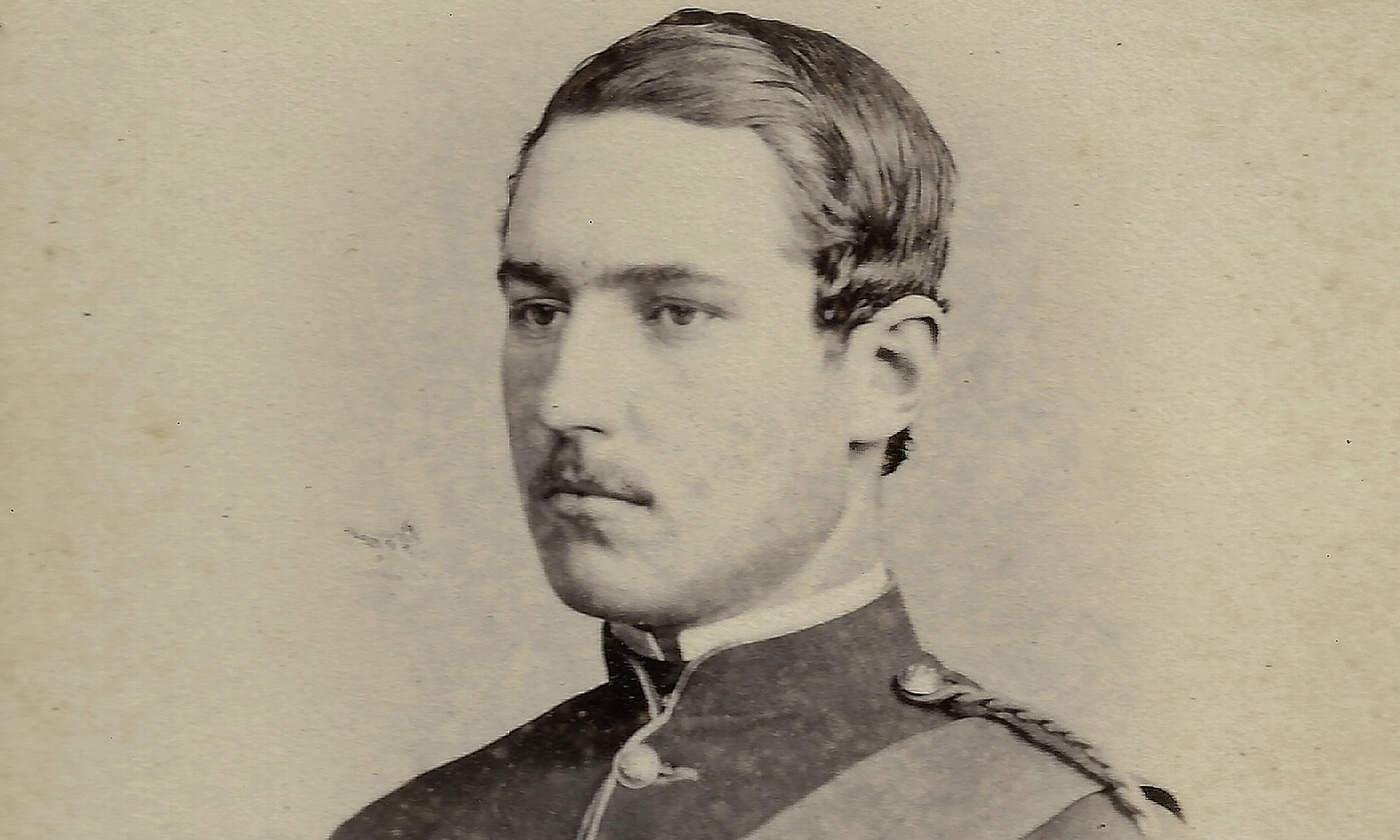
In March 1869, Charles William Hinde, pictured above at Poona, circa 1873, successfully passed his army direct commission examinations and joined the 83rd (County of Dublin) Regiment of Foot as Ensign by purchase, at this time garrisoned at Gibraltar.
Having served their time at Gibraltar, the 83rd Regiment embarked the troopship “Tamar” 11th March 1870 at the start of their journey to India. Arriving at Bombay 8th April 1870, the regiment then proceeded to Poona where it was quartered in Wanourie Barracks. Poona, located 120 miles southeast of Bombay in the western state of Maharashtra, was one of the most important military and administrative centres for the British in India.
In October 1871, Charles joined the Bombay Staff Corps and was promoted to Lieutenant without purchase. The Bombay Staff Corps was a branch of the Indian Army set up in 1861 to provide officers for the Indian native regiments and for the staff and army departments. Charles served with the 21st Bombay Native Infantry, stationed in Bombay, until in November 1874 when he was made Wing Subaltern and Adjutant to the 1st Bombay Native Infantry (Grenadiers).
In September 1878, Lord Lytton the Viceroy of India ordered a diplomatic mission to set out for the Afghan capital Kabul, where he hoped to establish a political residency. By establishing a British political mission in the Afghan capital, it was hoped that British India could control the foreign relations of this ‘buffer’ state and reduce Russian influence in the region. When, however, the mission was turned back at the eastern end of the Khyber Pass, the British decided to replace the Afghan leader Sher Ali by force.
By November 1878, three British columns, consisting of 40,000 men, prepared to invade Afghanistan. One column was to march through the Bolan Pass and seize the city of Kandahar, a second to occupy the Ali Masjid fortress and secure the Khyber Pass before advancing to Jalalabad, while the third would advance along the Kurram Valley towards Kabul.
In March 1880, the 650 men of the 1st Bombay Grenadiers, including Lieutenant Hinde, were ordered forward to reinforce the garrison at Kandahar.
Kandahar, in south Afghanistan, had been captured by Lieutenant-General Donald Stewart’s force without a struggle in January 1879. When, however, General Stewart headed north to Kabul with his British regiments and division of the Bengal Army, he left Kandahar with a much weaker garrison of mainly Indian troops, under the command of Major General Primrose.
In April 1880, word had reached Kandahar that Ayub Khan, the younger brother of the deposed Ameer Yakoub Khan, had amassed an army with the intention of expelling the British from Afghanistan.
In response, General Primrose appointed Brigadier General Burrows as commander of a field brigade sent out from Kandahar to oppose Ayub Khan’s army in early July. The brigade was made up of some 2,600 men but only included one British Regiment, the 474 men of the 66th Berkshire Regiment. Also included, was Lieutenant Hinde and the 650 men of the 1st Bombay Native Infantry (Grenadiers).
The Afghan force, which it was thought to have been around 3-4,000 strong, had been vastly underestimated. The actual numbers were more like to be around 11,000 men, but significantly the Afghans had 32 field guns, compared to the British 6 field guns and 6 smooth bore guns captured from the Afghans.
The Battle of Maiwand commenced at 10.30am 27th July 1880, near the village of Mundabad, with an artillery battle that initially lasted only 15 minutes. After some initial manoeuvres and engagements, Lieutenant Hinde and his Grenadiers were placed towards the left of the British line.
From that point onward, the day developed into a series of fanatical infantry and cavalry attacks from the Afghan forces. A combination of superior artillery firepower and repeated mass attacks from the Afghan infantry began to take a toll on the British line, and particularly on the morale of the Indian army ranks.
During the fighting that followed, a group of about 100-150 men were separated from the main body of retreating British troops and found themselves surrounded, defending a wall garden at the village of Khig.
By 4.00pm, General Burrows ordered the bugler to sound the retreat. By 5.00pm, towards Khig, there remained just eleven men of those trapped, and who were finished off by overwhelming numbers of enemy. Killed at this point were later found the body of Lieutenant Charles William Hinde 1st Bombay Native Infantry (Grenadiers).
By most accounts of the Battle of Maiwand, Charles was famously one of the last eleven men that made a final stand on the battlefield that day, bravely holding out against overwhelming odds and towards the end facing certain death.
Final British losses and casualty figures for the Battle of Maiwand were estimated at 1,000 officers and men plus 450 camp followers killed. The losses inflicted upon the Afghans were summed up by themselves as “beshumar” (countless), 3,000 to 4,000, and they added that it took them seven days to bury their dead. (Hills, The Bombay Field Force, 1880)
News of the British defeat was received at home with great shock and disbelief. It is thought that Charles’s father Major-General John Hinde C.B., who had been in failing health, was made worse by the news of his son’s death and died 7 months later 1st March 1881.
The loss of the Queen’s Colour and Regimental Colour of the 66th Regiment of Foot at the Battle of Maiwand, following so soon after the loss of the Colours of the 2nd/24th Regiment at the Battle of Isandlwana 22nd January 1879 during the Anglo-Zulu War, resulted in Regimental Colours no longer being taken on active service.
The wall of the north aisle in St Peter’s Church Powick bears an oval marble memorial, upon which are these words:
'In memory of Lieutenant and Adjutant Charles William Hinde, 1st Bombay Grenadiers, second son of Major General Hinde CB and Frances his wife, who was killed in action at Maiwand, Afghanistan on the 27th July 1880, in his 31st year of his age. He died as he had always lived, in the faithful execution of his duty.'
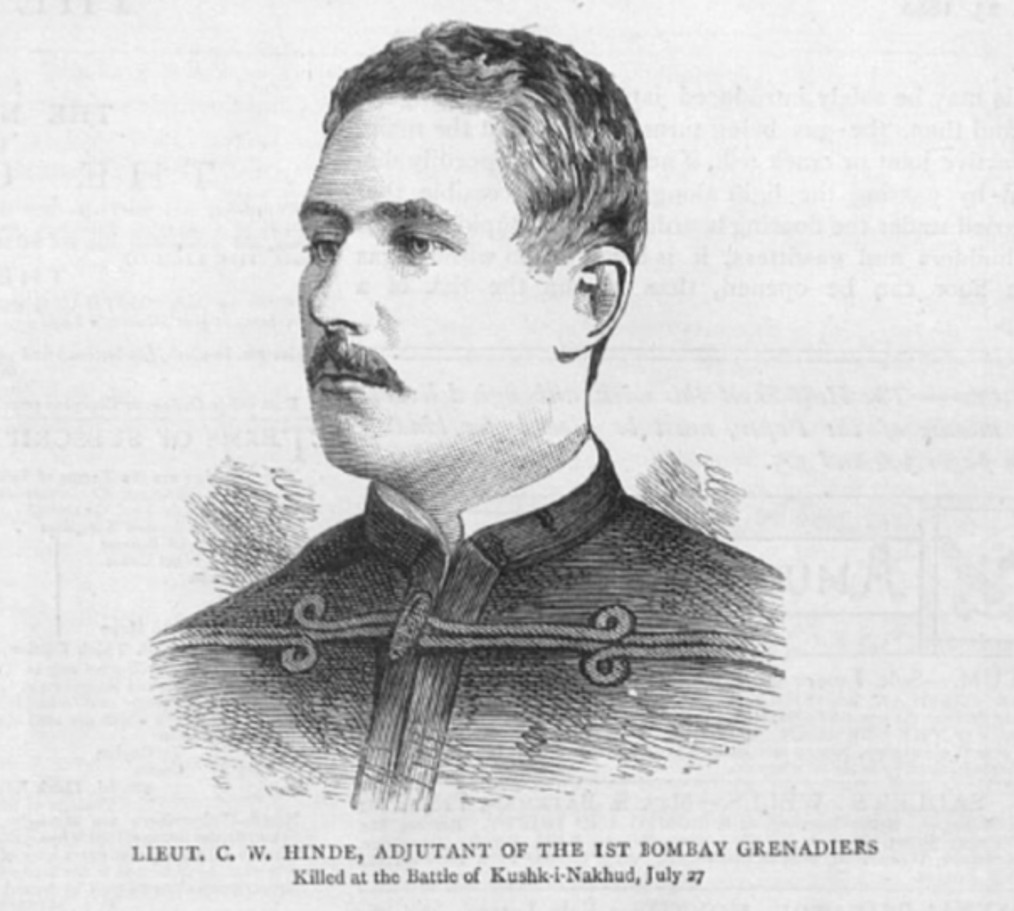
“He was one of the smartest and most popular officers in the service.” The Graphic, 23rd October 1880
For a more in-depth story of Charles William Hinde’s life, including detailed accounts of the British defeat at the Battle of Maiwand and the heroic part Charles Hinde played in it, plus more photographs, click here
Researched and written by Gary Hynard 2025