

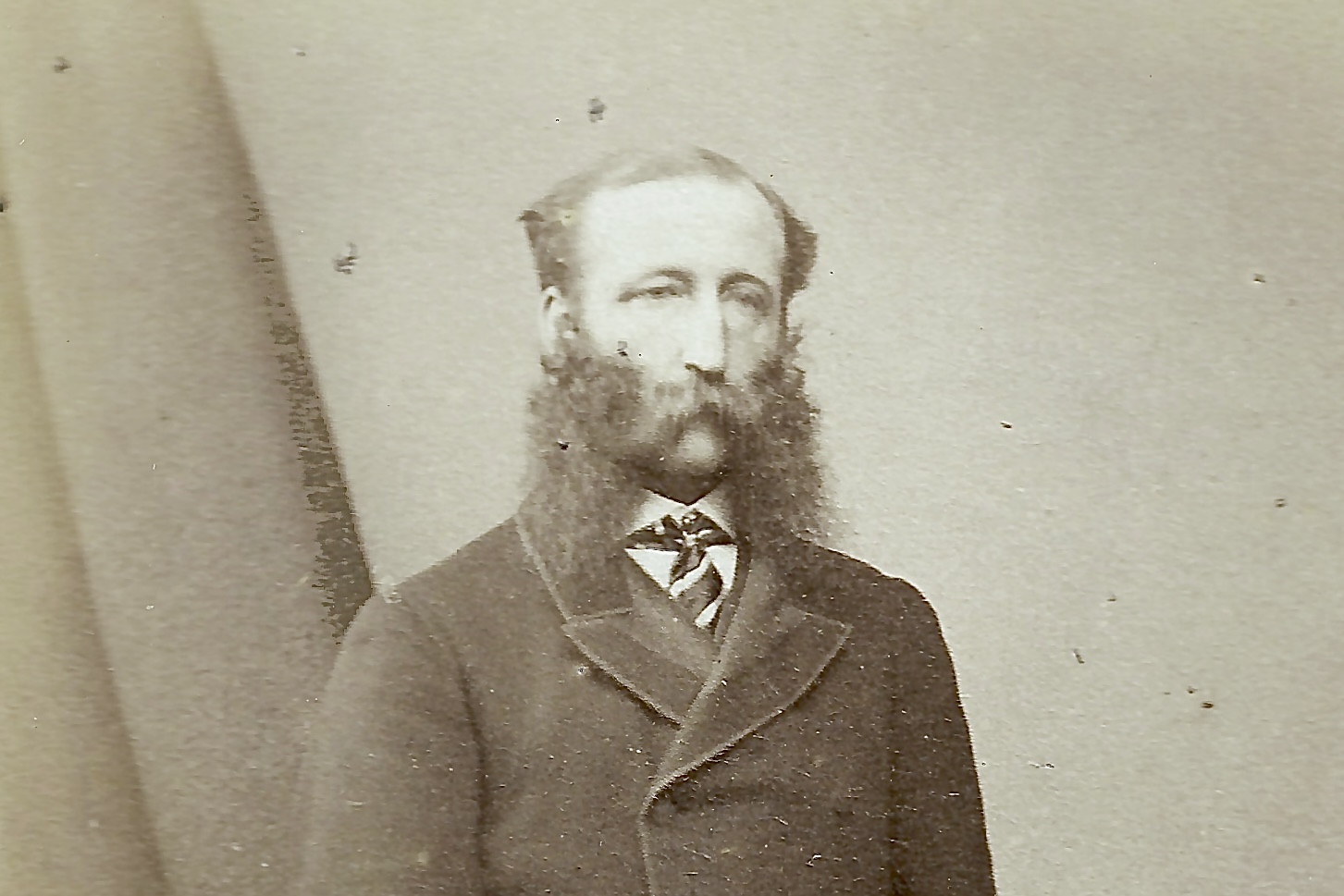
Crimean War – Siege of Sebastopol – India – Gibraltar
34th (Cumberland) Regiment of Foot – 83rd (County of Dublin) Regiment of Foot
John Francis Wise was born at Waterford, Ireland, 21st October 1832, the youngest son of Francis Wyse 1796-1855, and Mary Catherine Wyse (nee Hay) 1796-1865. John’s father Francis was the 3rd son of Thomas Wyse, of the Manor of St John, in the County and City of Waterford, Ireland.
Having studied at the Military Academy at 39 Great Brunswick Street, Dublin, in early May 1854 John Francis Wyse passed his army entrance examinations at the Royal Military College, Sandhurst. On 6th June 1854, John was commissioned Ensign without purchase with the 34th (Cumberland) Regiment of Foot.
In October 1853, the Ottoman Empire had declared war on Russia. The Crimean War 1853–1856 was primarily caused by long-standing tensions between major European powers over influence in the declining Ottoman Empire. At its heart, the war stemmed from a power struggle between Russia and the Ottoman Empire, with Britain and France becoming involved to counterbalance Russian ambitions.
The war eventually centred on the Crimean Peninsula, where key battles occurred, particularly the Battle of Alma 20th September 1854, Battle of Inkerman 5th November 1854, and the Siege of Sebastopol 17th October 1854 – 9th September 1855.
On 22nd November 1854, 21 officers, 35 Sergeants, 11 drummers, and 544 rank and file of the 34th Regiment, embarked its transport, and landed at Balaklava 9th December. Despite his young age and lack of experience, with his new regiment that day was the twenty-two year old Ensign John Francis Wyse.
On arrival at the front, the 34th Regiment joined the 1st brigade of the light division, and at once took up their share of trench and other duties before the besieged city of Sebastopol.
Over the next 9 months, John Wyse and the 34th Regiment remained in the trenches enduring harsh winter conditions, and trench warfare that had become a stalemate, with the British and French forces failing to break through the Russian defences.
During this time, the regiment suffered significant losses from illness brought on by exposure and the inadequate provision of supplies. It also suffered heavy casualties during an attack on the Russian defensive positions 18th June and 8th September 1855.
British losses for the 18th of June attack on the Great Redan, were 1,553 killed and wounded, including 100 officers. (Historical Account of the 34th and 55th Regiments, 1875). Of the many 34th Regiment men who distinguished themselves by their gallant conduct that day, an Irishman Lieutenant Boyce was singled out.
Lieutenant Boyce’s actions that day earned him the Sardinian Crimean War Medal. The Sardinian Crimean War Medal was a gallantry medal awarded by King Victor Emmanuel II of Sardinia for bravery during the Crimean War (1853-1856) against the Russian Empire.
Lieutenant Boyce was one of 450 men selected to receive the medal, his citation read:
“For having at the assault on the Redan on the 18th June 1855, after the troops had retired to the Trenches, gone out in front of the advanced Trench under a heavy fire of grape, and rendered great assistance in bringing in Lieutenant and Adjutant Hobson, 7th Fusiliers, who was lying outside, severely wounded.”
With so many officers of the 34th Regiment killed or wounded in the attack of 18th June 1855, Irishmen Lieutenants Boyce and Wyse, were both put in command of companies, a role normally carried out by a Captain.
On 25th July 1855, John Wyse was injured while in charge of the “Rifle Pits”, receiving a contusion most likely from an exploding shell.
On 8th September 1855, a combined British and French attack on the Russian defences of the Great Redan and Malokoff Tower, although only partially successful, proved to be a turning point of the siege.
The Russians made repeated attempts during the day to recapture the Malakoff from the French forces who had captured it earlier in the day, but all were unsuccessful. Despite being a disastrous a day for the allies, five out of the six columns of attack were defeated, the capture of the Malakoff was significant, as it commanded so many of the Russians defensive works, they had now become quite untenable.
In what turned out to be the last day of battle during the siege, British losses amounted to 29 officers and 336 men killed, 124 officers and 1,762 men wounded, and 1 officer and 175 men missing, making a total loss for the single days battle of 154 officers and 2,273 men.
On this last day of fighting, the 34th Regiment, had 8 men killed, and Lieutenants Harris and Dyson-Laurie and 53 men wounded, of whom 4 died shortly afterwards. Both Lieutenants Boyce and Wyse survived the day unhurt.
It was planned to renew the assault the next morning, but during the night it was discovered that the Great Redan had been deserted by the Russians. A number of loud explosions, as well as several fires in the town, suggested something unusual was happening. As the sun came up on 9th September, it was found that the Russians had abandoned all their positions and evacuated the city.
In the months following the end of the siege, John remained with his regiment at Sebastopol employed making roads and in destroying all the remaining forts, docks, and public buildings in the city. It seems, however, that at some point John may have fallen ill with one of the many diseases that plagued the troops at this time. John was evacuated on the SS Great Britain, embarking Constantinople 11th December 1855, and arriving Spithead 30th December. For his part in the Crimean War, John Wyse received the Turkish Crimean War Medal and Crimea Medal with Sebastopol clasp.
The Crimean War was finally ended by peace negotiations at the Congress of Paris, resulting in the signing of the Treaty of Paris 30th March 1856.
The war now ended, the 34th (Cumberland) Regiment of Foot returned to England embarking the SS Prince Arthur on 14th June 1856, and landing at Portsmouth 11th August 1856. From there they proceeded to the camp at Aldershot, and shortly afterwards to Glasgow, and then finally to Edinburgh.
In early 1857, an uprising within the Bengal native army occurred in British ruled India. Between July and November 1857, a total of 84 troopships left England carrying reinforcements bound for India. On one of those ships the “Golden Fleece” were the officers and men of the 34th Regiment bound for Alexandria, and then via the overland route to Suez before embarking for Madras.
At this time, John had remained in England with the regiment’s depot companies, and in March 1858 was appointed assistant rifle instructor for the 1st Battalion 34th Regiment.
By June 1860, with the Indian Rebellion put down, John Wyse travelled to India, rejoining his regiment at Fyzabad, before In December 1861, the regiment was moved from Fyzabad to Seetapore and Toy Bareilly, a wing being at each station.
On 10th April 1861, John married a Mary Jamina Jane Onslow, only daughter of the late Rev. Arthur Onslow at the Old Church, Fort William, Calcutta. Between April 1862 and March 1863, John was made acting Adjutant for the 34th Regiment. John gave up this role when he was promoted to Captain without purchase 3rd March 1863.
By April 1863, John was suffering from an illness and ordered to spend some time recovering at Simila and the hills north of Deyrah. His medical certificate initially granted leave until 13th July, but this was later extended to 13th October.
In December 1864, John Wyse was reported as “doing duty” from the date of embarkation, with a detachment of invalided troops returning to England on the Sailing Ship Trafalgar. It was further reported that he would spend “17 months on Private Affairs”. The term “Private Affairs” was often used as a euphemism for sick leave, hiding the fact that many officers needed to return home for treatment or to recover from illness.
The Trafalgar arrived at Spithead 9th March 1865, with invalided troops on board for transport to the Royal Victoria Military Hospital at Netley.
After serving 13 years with the 34th Regiment, in November 1867, John exchanged regiments, joining the 83rd (County of Dublin) Regiment of Foot, at this time garrisoned at Gibraltar. Within 6 months, however, John Wyse retired from the army.
In retirement, John and his wife Mary lived in London, and by 1871 were living at an address in Paddington. Now retired, John became Secretary of a gentlemen’s club, The International Club in London, was a member of the Royal Horticultural Society and a fellow of the Royal Botanic Society.
John Francis Wyse died suddenly of a heart attack at the age of 52, 17th April 1885. John’s wife Mary died some 15 years after John, 3rd July 1900, she was living in Broadstairs in Kent.
Captain John Francis Wyse was an Irish officer, who served with distinction in the British Army during the mid-19th century. He was among the many Irishmen who took part in Britain’s imperial campaigns, most notably the Crimean War 1853-1856. In that brutal conflict, marked by harsh winters, inadequate supplies, and heavy casualties, a young John Wyse endured the trench conditions, battlefield dangers, and widespread disease that claimed the lives of so many soldiers. His survival of the campaign was a testament to his resilience and fortitude.
Following his service in Crimea, John Wyse continued his military career in India. Like many officers stationed there, he faced the difficult realities of service in a foreign climate, where tropical illnesses such as dysentery, cholera, and malaria were constant threats. Within three years of arriving in India, John Wyse was suffering from a severe illness, an affliction that left a lasting mark on his health.
His military career stands as part of the broader story of Irish participation in the British Army during the Victorian era, an era when Irish officers and soldiers played a significant role in Britain’s global wars and colonial campaigns, often at great personal cost.
For a more in-depth story of John Francis Wyse’s life, including detailed accounts of the trench warfare and appalling loss of life during the Siege of Sebastopol in 1855, including John’s own personal account written from the trenches, plus more photographs click here
Researched and written by Gary Hynard 2025