

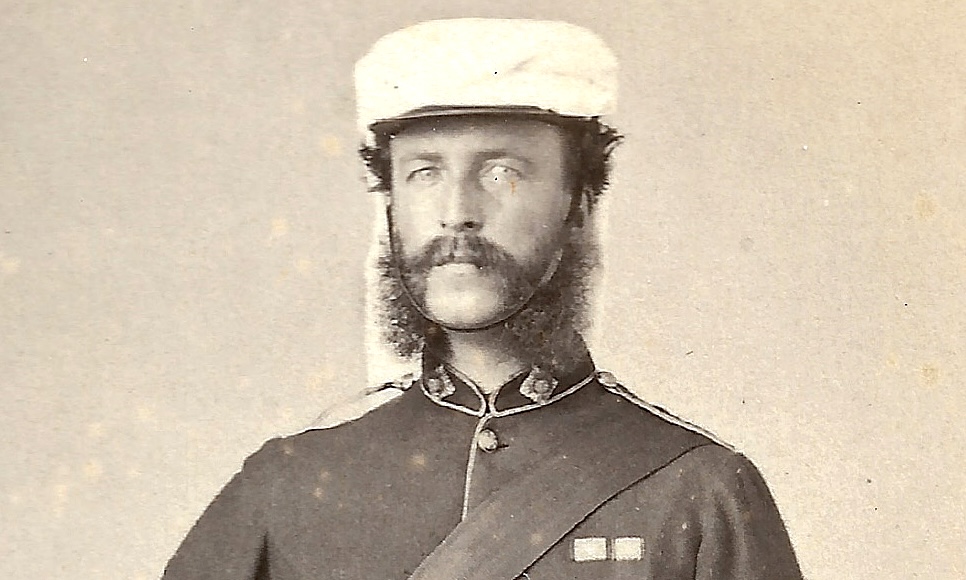
Crimean War – Siege of Sebastopol – Mauritius – India – Gibraltar
4th (Kings Own) Regiment of Foot – 83rd (County of Dublin) Regiment of Foot
Born 16th July 1834 at Ditchingham, Norfolk, John Philip Bohun Forster was one of two children born to Major Peter Forster 1770-1845 and Clara Susan Forster (nee Bohun) 1800-1881. John had a sister, Elizabeth Clara Forster 1837-1917, who died a spinster in Plomesgate, Suffolk, in 1917.
Educated at Eton between 1847-1850, John joined the 4th (King’s Own) Regiment of Foot as Ensign by purchase, 10th July 1852.
The 4th (King’s Own) Regiment was originally formed in 1680 to defend Tangier, a British possession in North Africa. It was initially known as the 2nd Tangier Regiment and later became the 4th Regiment of Foot.
When John joined the 4th (King’s Own) Regiment in July 1852, it was stationed at various camps throughout the Midlands, before being moved to Scotland in May 1853. Garrisoned at Edinburgh Castle, within eight months of arriving in Edinburgh, it was reported that the 4th Regiment was under orders for Constantinople, where it would form part of the British forces being prepared to attack the Russian army at Sebastopol, in the Crimea.
In October 1853, the Ottoman Empire had declared war on Russia.
Britain and France, wary of Russian expansion and the threat to the balance of power in Europe, allied with the Ottoman Empire. They feared Russian control of Constantinople would give it dominance over Mediterranean trade routes and threaten British interests in India.
The war eventually centered on the Crimean Peninsula, where key battles occurred, particularly the Siege of Sebastopol 17th October 1854 – 9th September 1855.
On Wednesday 9th March 1854, the 4th (King’s Own) Regiment of Foot had embarked the “Golden Fleece” steamship, for transport to Malta before travelling onto Constantinople. The three-mile route to Granton docks from the Edinburgh Castle, was lined by an estimated 30,000 spectators and well-wishers. The strength of the regiment that embarked that day was 37 officers, 47 sergeants, 16 drummers and 850 men.
By 25th March 1854, the regiment had reached Malta where it disembarked for three weeks, before travelling onto Gallipoli in mid-April. During his time at Gallipoli, John was promoted to Lieutenant 15th August without purchase.
The King’s Own were brigaded with Gloucesters and the Essex Regiment and finally reached the Crimea on 14th September 1854.
On 28th September, elements of the 4th King’s Own, had been moved up to trenches within 1000 yards of the besieged city of Sebastopol.
Towards the end of March 1855, the left wing of the King’s Own, including the 20-year-old Lieutenant John Forster, left Gallipoli to join headquarters before Sebastopol. On 1st May 1855, John was promoted in the field to Captain by purchase.
Over the next five months, John Forster and the rest of the King’s Own Regiment endured the constant threat of death and severe conditions of the trench warfare that had become a stalemate, with the British and French forces failing to break through the Russian defences.
After 337 days, however, the siege of Sebastopol ended when the city finally fell 9th September 1855, but only after the Russians abandoned their positions.
The Crimean War was finally ended by peace negotiations at the Congress of Paris which resulted in the signing of the Treaty of Paris 30th March 1856. The war now ended, the 4th (King’s Own) Regiment returned to England aboard the steamship “Exmouth”, arriving at Portsmouth 20th July 1856, with half of the men that had embarked two years previously. Of the 340 men lost on the campaign, only thirty-eight had been killed in action at Alma and Sebastopol.
For his part in the Crimean War, John received the Turkish Crimean War Medal and Crimea Medal with Sebastopol clasp.
Following their return to England, the regiment spent some time camped at Aldershot, before being transported to Ireland by special trains, arriving in Kingstown, Ireland, 25th August, and then onto the Curragh Army Camp.
Within nine months of arriving in Ireland, the King’s Own Regiment was embarking at Kingstown, aboard the troopship “Lord Raglan,” bound for Mauritius in the East Indies.
Captain John Forster remained in Mauritius with the regiment, until he returned to England.
In January 1860, newspapers reported the arrival at Bombay of 285 troops of the 1st Battalion 4th King’s Own from England, under the command of Captain John Philip Bohun Forster.
Having return to India, in November the same year, John was granted 15 months leave on what was described as “private affairs”, during which time he and his family returned to England. The term “private affairs” was often used as a euphemism for sick leave, hiding the fact that many officers needed to return home for treatment or to recover from illness.
On 7th April 1865, John was promoted to Major without purchase, he was 31 years old and had served with the 4th (King’s Own) Regiment of Foot for 13 years.
In August the same year, John exchanged into the 83rd (County of Dublin) Regiment of Foot, at the time stationed in England. In January 1866, the regiment was shipped from Liverpool to Ireland, where it would stay until April 1867.
After a brief stay in Ireland, the 83rd Regiment including John, embarked at Kingstown in April 1867 and were conveyed by the troopship “Himalaya” to Gibraltar. Relieving the 86th (Royal County Down) Regiment in the Casemate Barracks, the 83rd Regiment would spend the next 3 years on garrison duty at Gibraltar.
In September 1868, Major John Philip Bohun Forster retired from the army, aged thirty-four.
He died 11th January 1878 in Aldeburgh, Suffolk, he was forty-three years old. John was buried in St Peter and St Paul’s Church, Aldeburgh, Suffolk.
For a more in-depth story of John Philip Bohun Forster’s life, to hear detailed accounts of the Siege of Sebastopol, and to see more photographs, click here
Researched and written by Gary Hynard 2025
Major John P B Forster Gibraltar circa 1868