

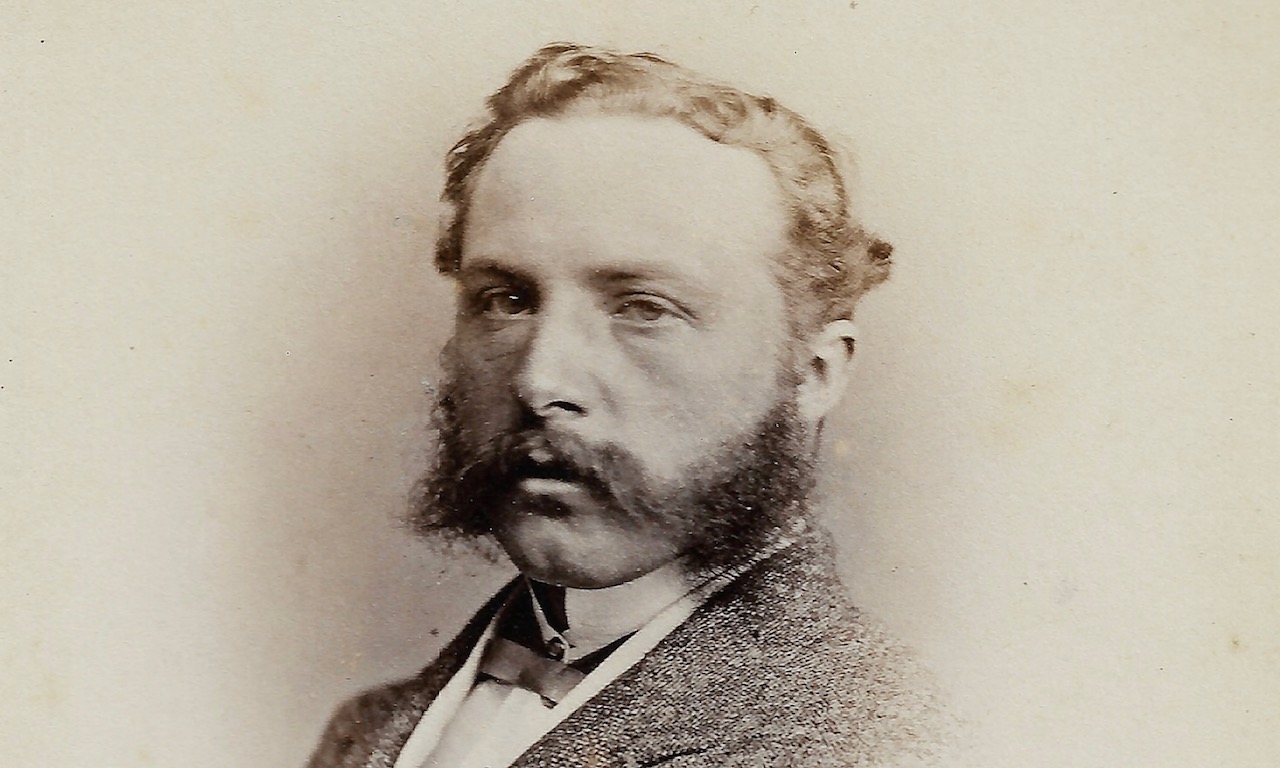
Trinity College Cambridge – 83rd Regiment of Foot – Royal Irish Rifles
Booth Hay Metcalfe was born in the small village of Muker, North Yorkshire, 17th February 1843. Eldest son of Lister Washington Metcalfe 1777-1846, a Cheese Factor (Wolesaler), and Margaret Metcalfe (nee Williamson) 1803-1886. Booth Hay Metcalfe was one of six children born to the couple between 1834 and 1846.
Having been educated at Richmond Grammar School, Yorkshire, Booth entered Trinity College, Cambridge, in 1861, graduating with a BA in 1865. On 2nd June 1865, Booth joined the 83rd (County of Dublin) Regiment of Foot as Ensign by purchase, at this time based at various locations throughout England.
Over a distinguished 22-year military career with the 83rd (County of Dublin) Regiment of Foot, Booth’s achievements, promotions, and postings are set out below:
- Between January 1866 and April 1867, the regiment was stationed in Ireland.
- In April 1867, the 83rd Regiment was shipped to Gibraltar, where it would be garrisoned until March 1870. From Gibraltar, the regiment was transported to India, where it would spend the next 10 years.
- In September 1867, Booth was promoted to Lieutenant by purchase, and in November 1870 to Captain, also by purchase.
- In 1871, Booth was ordered to return to England, and take up command of the regimental depot companies, based at Chatham, Kent.
- Booth remained with the depot companies, returning to Ireland in November 1872, until 1874 when he returned to India to rejoin the regiment.
- By June 1876, Booth was suffering from frequent attacks of Malaria, so bad that he was once again ordered back to England to join the depot companies’ station there.
- Booth remained in England, until returning to India in April 1880.
- Towards the end of 1880, the regiment was ordered to return to England. In January 1881, however, the 42 Officers and 1,308 men of the 83rd Regiment on board the troopship “Crocodile” were diverted to Natal in South Africa, where an outbreak of hostilities with the Boers would see the regiment on active field service.
- In July 1881, the 83rd (County of Dublin) Regiment of Foot became the 1st Battalion Royal Irish Rifles, under the Childers reforms.
- After spending much of its time on rear-area labouring duties in South Africa, the Battalion returned to England in January 1882.
- On 18th January 1882, Booth was promoted to Major by purchase.
- In December 1884, the troopship “Assistance” left Dover carrying Major Metcalfe and the men of the 1st Battalion Royal Irish Rifles to be stationed in Guernsey.
- By 1887, Booth had returned to Dover where he retired 31st December 1887, with the honorary rank of Lieutenant Colonel.
In retirement, Booth enjoyed pursuing his passion for sports, in particular sailing. He was a member the Royal Victoria and Royal Cinque Ports Yacht Club.
In his private life, Booth had a relationship with a Jane Cora Searle (1851-1928), with whom he had three children between 1884 and 1893. The couple were not married and mostly lived apart, until they married in 1903 and moved to the Isle of Wight.
Booth remained on the Isle of Wight until 15th February 1924, when he died aged 80 years.
The Yorkshire Post carried an article published 20th February 1924, which read:
“The death took place at Ryde last Friday in his 81st year of Lieutenant Colonel Booth Hay Metcalfe of Muker Yorkshire and Beechwood Ryde. The Times Correspondents writes: He was one of the oldest surviving graduates of the early sixties at Trinity Cambridge where he made a name in perhaps the best college boat of this period. Many of his years service were spent in India, and he saw service with his regiment in the first Boer War. He was a good cricketer and better boxer. A keen shot, he made good practice the birds until at the age of 75 the injury which finally led to his death manifested itself. Like all the men of his family he loved horses and rode well but most of all he loved the sea owned a succession of well-known yachts and was one of the oldest members of the Royal Victoria and Royal Cinque Ports Yacht Club. A man of most generous nature his loss will be deeply felt not only by his contemporaries but by many of us a younger generation to whom he stood as the best type of English Gentleman. He leaves a wife and 3 sons.”
For a more in-depth story of Booth Hay Metcalfe’s life, and for more photographs, click here
Researched and written by Gary Hynard 2025