

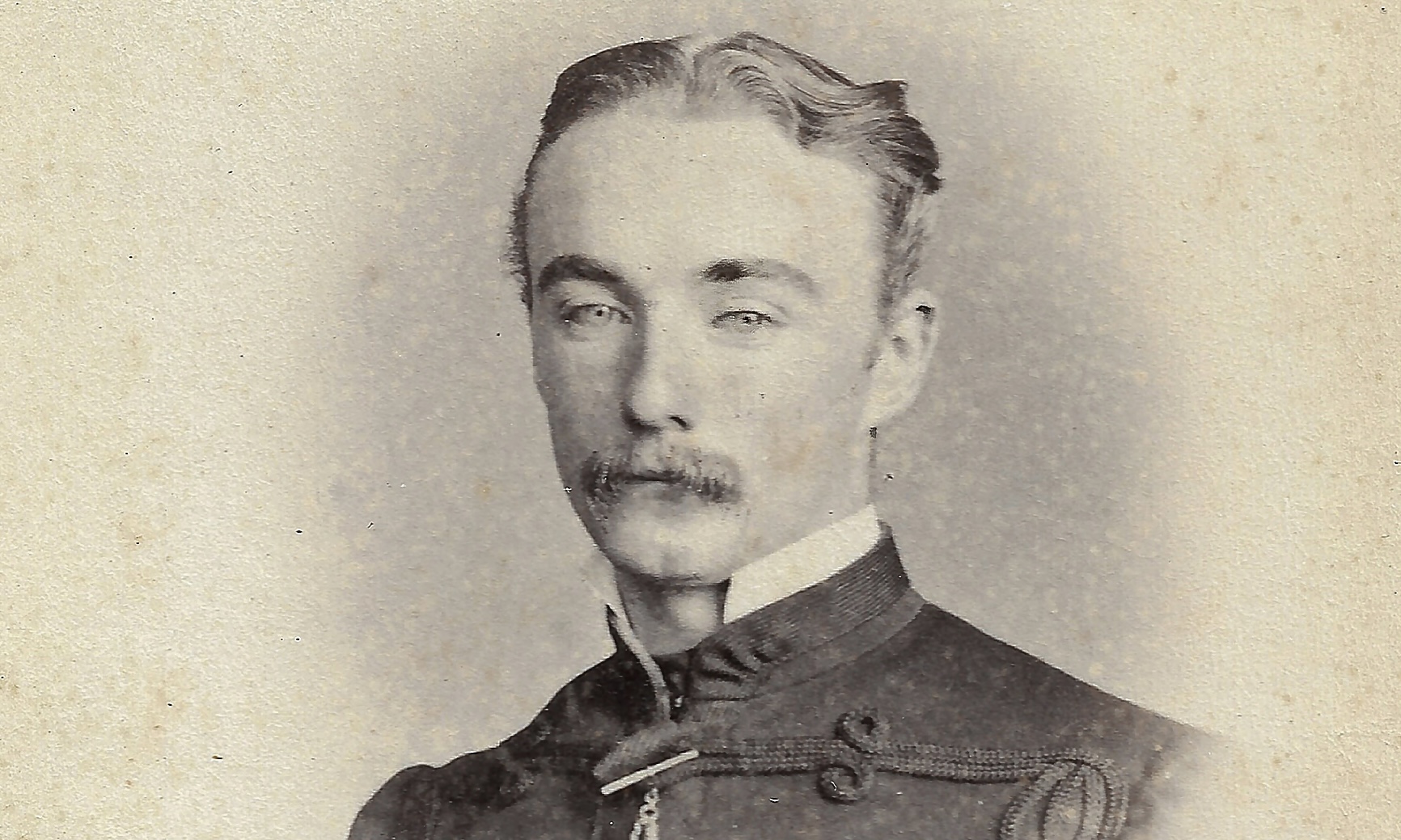
83rd (County of Dublin) Regiment of Foot – Dublin County Light Infantry
Royal Dublin Fusiliers – Dublin Castle Scandal 1884
Martin Oranmore Kirwan was born 26th April 1847 in Dublin, Ireland, the son of Captain Richard Andrew Hyacinth Kirwan 1813-1886 of Baunmore County Galway and Agnes Jane Kirwan (nee Thompson) 1815-1884.
Following his formal education, Martin Kirwan purchased a commission as Ensign with 20th (East Devonshire) Regiment of Foot in May 1867 aged 20. Within weeks, however, he exchanged into the 83rd (County of Dublin) Regiment of Foot in June 1867.
After spending some time with the regiment’s depot companies in Colchester, England, Martin traveled to join his new regiment garrisoned at Gibraltar in December 1867.
The 83rd Regiment, recently arrived from Ireland, was due to spend the next two years garrisoned at Gibraltar. Officers could expect to engage in a variety of activities, socialise with one another and local civilian population, attending formal dinners, balls, receptions, and occasional outings to scenic spots at Gibraltar and in Spain. Sports were also a common pastime, and the officers would have played games like cricket, tennis, or racquet sports, as well as participated in riding or hunting on the mainland.
During his time at Gibraltar, Martin like many of his fellow officers joined the Freemasons, an institution involved in various aspects of society, including politics, social reform, and community development. Martin also played an active part in an amateur dramatics group that put on regular shows to entertain the troops. He was promoted to Lieutenant by purchase 11th January 1869.
Having served their time at Gibraltar, the 83rd Regiment commanded by Colonel A. B. Hankey, embarked the troopship “Tamar” 11th March 1870, and proceeded to Alexandria on the Mediterranean coast of Egypt. From Alexandria they travelled by train to Suez on the Red Sea and on 25th March embarked the troopship “Euphrates” for onward transport to India. Arriving at Bombay 8th April 1870, the regiment then proceeded to Poona where it was quartered in Wanourie Barracks.
In June 1871, Martin Kirwan resigned his commission after serving only four years with the 83rd Regiment and return to Ireland. In the same year, he joined the Dublin County Light Infantry as a Supernumerary Lieutenant. In April 1880, Lieutenant Martin Kirwan was promoted to Captain.
In 1881, the Dublin County Light Infantry were amalgamated with the Royal Bombay Fusiliers and Royal Madras Fusiliers, two army regiments stationed in India, and another militia unit from County Kildare as part of the Childers Reforms, to form The Royal Dublin Fusiliers.
In addition to his military duties, Martin was involved with local charitable works for the poor and infirm, and a parishioner’s church warden at St Stephen’s Church Dublin. Martin was elected as a member of the Royal Horticulture Society during a council meeting in January 1879. The meeting was chaired by Gustavus C. Cornwall, who five years later would appear in court with Martin Kirwan as a co-conspirator in a trial that shocked the establishment.
By 1884, a political war existed in Ireland between the Home Rule movement and the British administration. When an Irish Nationalist MP Tim Healy accused two high level British officials with being homosexual, it exposed Dublin’s clandestine male homosexual community. What began as accusations in the press concerning two government officials, led to a number of high-profile court cases and the prosecution of several prominent individuals. Collectively, these cases became known as ‘The Dublin Castle Scandals 1884’.
On 2nd August 1884, Martin Kirwan was one of four men arrested and taken to Kilmainham Prison on a charge of committing, attempting, inciting, and conspiring to commit Buggery. Those men arrested that day with Kirwan, were James French a detective inspector 43, James Pillar wine merchant 62, and Johnston Lyttle distillers’ clerk 20.
In late August, Martin Kirwan and Gustavus Charles Cornwall, late Secretary of the General Post Office, were tried for conspiring together to procure persons to commit immoral offences. After a short trial, both men were acquitted of the charges and released.
Despite being found not guilty of the charges brought against him, Martin Kirwan’s involvement in the scandal, and by association with some of the men who were convicted, meant that he was forced to resign his commission with the Royal Dublin Fusiliers.
The scandal subjected Kirwan to public scrutiny and social ostracism. His involvement in the scandal, even without a conviction, led to a tarnished reputation. The media coverage and public discourse surrounding the trial only reinforced negative stereotypes about homosexuality, associating it with moral corruption and criminality. As a result, it is likely that Martin Kirwan would have faced some social isolation and diminished status within his community.
In 1886, upon the death of his father Richard Kirwan, Martin Kirwan succeeded to his father’s estate. It was here in Galway that perhaps Martin Kirwan escaped the wider public scrutiny and began to regain some of his standing within his community. In addition to overseeing his estate, Martin Kirwan served as a governor of the County Infirmary, was an active committee member of the County of Galway Horticultural and Home Industrial Society and regularly contributed to local taxes as a cesspayer.
Martin Kirwan lived at Baunmore House County Galway and never married. He died on Tuesday 17th May 1904 aged 57, and laid to rest at the Mount Jerome Cemetery, Harold’s Cross, County Dublin, Ireland, on Saturday 21st May 1904.
The Tuam Herald 28th May 1904, wrote of Martin Kirwan
‘…he was a considerate landlord, and highly esteemed by his tenantry, and his loss is mourned by all who knew his many virtues both in the city and county of Galway. The remains arrived in Galway from Baunmore on Saturday, en route for Dublin.’
For a more in-depth story of Martin Oranmore Kirwan’s life, his involvement in the Dublin Castle Scandal 1884, and to see previously undiscovered photographs click here
Researched and written by Gary Hynard 2025