

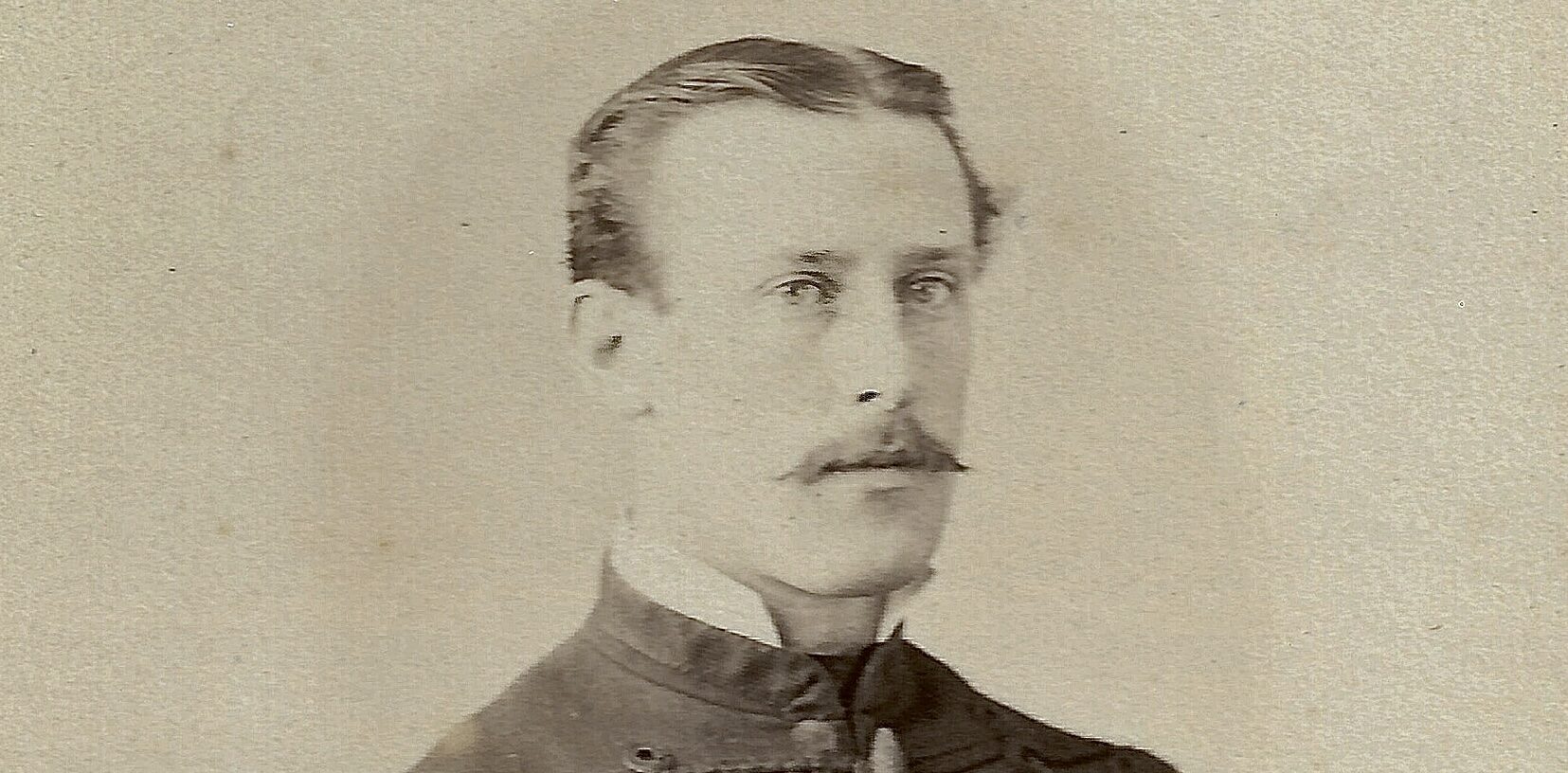
83rd Regiment – Bombay Staff Corps – Afghanistan – Egypt – Sudan
South Africa – King’s Royal Rifles – ADC to King
William Cooke-Collis was born 1st August 1847 at Fermoy, County Cork, Ireland, the son of the Reverend Maurice Atkin Cooke-Collis DD 1812-1882 and Anne Cooke-Collis (nee Talbot) 1812-1896.
William grew up at the family home Castle Cooke in Ireland, part of an extensive estate owned by his father. Following his formal education in England, William joined the army in April 1866, purchasing a commission as Ensign with the 83rd (County of Dublin) Regiment of Foot.
In March 1867, the depot companies of the 83rd Regiment were moved from Dublin to Colchester in England. In April, the regiment embarked the troopship “Himalaya” at Kingstown Ireland, from where it was transported to Gibraltar.
In July 1868, William Cooke-Collis was promoted to Lieutenant and made Adjutant with the 83rd Regiment, a position he held until the regiment was moved to India in 1870. The role of the Adjutant was essential to the effective functioning of a regiment. Typically, a junior officer, such as a lieutenant or captain, the Adjutant assisted the commanding officer with the daily management of the regiment.
Having served their time at Gibraltar, on 11th March 1870, the 83rd Regiment embarked the troopship “Tamar”, and proceeded to Alexandria on the Mediterranean coast of Egypt. From there they were transported by railway to the port of Suez on the Red Sea, and on 25th March embarked the troopship “Euphrates” for onward transport to India.
Arriving at Bombay 8th April 1870, the regiment travelled to Poona, where it would be quartered in Wanourie Barracks. Poona, located 120 miles southeast of Bombay in the western state of Maharashtra, was one of the most important military and administrative centres for the British in India.
In India, William joined the Bombay Staff Corps, a branch of the Indian army created during the British Raj. Separate Staff Corps were formed in 1861 for the Bengal, Madras and Bombay armies, which were later combined into the Indian army. The Staff Corps provided trained British officers for the Indian native regiments.
Within a year of arriving in India, William was granted 15 months leave, returning to Ireland on private affairs. William travelled back to India in March 1872, resuming charge of the station staff and communications office at Ahmednagar.
In 1875, William was moved to Poona, where on 6th November 1875, he married Katherine Oliphant, the daughter of Lieutenant Colonel Oliphant Royal Engineers. On 7th May the following year, William and Katherine had a son at Ahmednagar, only six months after they were married. Between 1876 and 1885, the couple had six children.
In April 1877, William was promoted to Captain, before being appointed as Deputy Assistant Adjutant General with the Bombay Staff Corps.
In September 1878, Lord Lytton, the Viceroy of India, ordered a diplomatic mission to set out for the Afghan capital Kabul, where he hoped to establish a political residency. When, however, the mission was turned back at the eastern end of the Khyber Pass, the British decided to replace the Afghan leader Sher Ali by force.
By November 1878, three British columns, consisting of 40,000 men, prepared to invade Afghanistan. One column was to march through the Bolan Pass and seize the city of Kandahar, a second to occupy the Ali Masjid fortress and secure the Khyber Pass before advancing to Jalalabad, while the third would advance along the Kurram Valley towards Kabul.
Between April and July 1880, William’s brigade operated between Sibi and Kandahar via the Bolan Pass, a distance of 261 miles. Their job was to maintain roads and provide security for the safe transport of supplies, and to ensure that open lines of communication were maintained.
On 28th July 1880, news reached William’s brigade that General Burrows forces had been defeated at the Battle of Maiwand the day before, with the loss of over 1,000 men killed or wounded. The victorious Afghan army pursued the surviving British forces back to Kandahar, and laid siege to the city.
In response, General Roberts led a force of 10,000 British and Indian soldiers, 300 miles in twenty-three days from Kabul to Kandahar, to defeat the Afghan army of Ayub Khan. Despite the difficult terrain and oppressive heat, the force covered the distance, hardly losing a man.
At the same time, Brigadier General Phayre commanded a separate column of 6,000 British and Indian troops including William, marching 93 miles in just ten days. On 1st September 1880, Ayub Khan’s army outside Kandahar was defeated and the siege ended.
For his part in the Anglo-Afghan War 1878-80, including the relief of Kandahar, William was mentioned in dispatches. Brigadier General Phayre wrote of William:
“To Captain William Cooke-Collis 83rd Regiment of Foot Assistant Adjutant General my hearty thanks are due for his valuable services, commencing in April last as Brigade Major on the line of communications. His arduous duties have been performed ably and promptly.”
By March 1881, William was reported to be back in Bombay and during the same year, William returned to Ireland where he rejoined the 83rd regiment’s depot companies. During 1881, under the Childers Reforms, the 83rd (County of Dublin) Regiment of Foot was combined with the 86th (Royal County Down) Regiment of Foot, to form the Royal Irish Rifles.
In 1882, William inherited the family home Castle Cooke, following the death of his father Maurice Atkin Cooke-Collis who died 8th December 1882 at Queenstown, Ireland.
On 1st April 1883, William joined the Staff of the Northern Division at York as Deputy Assistant Adjutant and Quartermaster General.
British forces had occupied Egypt in 1882 to safeguard the Suez Canal and protect British financial interests. As a result of the occupation, British troops intervened in neighbouring Sudan, where British, Egyptian, and Indian troops fought two bitter wars against rebellious Islamic tribesmen (Mahdists), the followers of Muhammad Ahmad, the self-proclaimed Mahdi.
Despite a successful campaign against mahdist rebels, operating in the Suakin area of Sudan, in January 1884, in February 1885, William was reported to be on the staff list of officers on the staff of a second expedition to Suakin.
By March 1885, the British had assembled a field force of some 10,500 British and Indian troops at Suakin. On 22nd March 1885, within only 5 miles from the port of Suakin, a contingent of some 3,000 British and Indian troops, led by Major General Sir John Carstairs McNeill, were attacked by a Mahdist force. The Mahdists were heavily defeated, losing some 1,000 of their 2,000 fighters, compared to the loss of 70 British and Indian soldiers killed and over 100 wounded.
The Suakin Field Force was withdrawn during the same year. In despatches, General Graham singled out William, amongst other staff officers, for special mention for services rendered by him during the campaign.
Returning from the Sudan, William was promoted to Major and resumed his position as Deputy Assistant Adjutant General for the Northern District based in York.
By December 1889, William had returned to Ireland and was appointed second in command of the 1st Battalion Royal Irish Rifles based at Mullingar County Westmeath.
On 27th January 1891, William’s wife Catherine died in Ireland, she was only 40 years old.
In 1892, William was promoted to Lieutenant Colonel, second in command of the 1st Battalion Royal Irish Rifles, before retiring in May that year.
Two years later, in 1894 William was appointed to command the 9th Battalion King’s Royal Rifles, better known as the North Cork Militia.
During the same year, William married Elizabeth Marion Shrubsole Cunliffe 1864-1926, 4th Sept 1894, at All Saints Church, Marylebone, London. The couple went on to have five children, born between 1896 and 1906.
The Second Boer War started in October 1899 and lasted until May 1902. The war was fought in Southern Africa between Britain and the Afrikaans-speaking Dutch settlers of two independent Boer republics, the South African Republic (Transvaal Republic) and the Orange Free State.
At the news of the outbreak of war in South Africa, the 9th Battalion King’s Royal Rifles were one of the first militia battalions to volunteer for active duty. William wired the War Office notifying them of the wish of the men to “share the fortunes of their comrades in the field.” His request was accepted and subsequently received orders that the battalion should make ready for active service.
During their time in South Africa, William’s Battalion carried out escort and guard duties, protecting lines of communications, railway tracks and bridges. Having served for 17 months in South Africa, the 9th Battalion King’s Royal Irish Rifles embarked the SS Pinemore at Cape Town 6th July 1901, arriving back in Ireland 31st July 1901.
For his service in South Africa, William was awarded the Most Distinguished Order of Saint Michael and Saint George C.M.G.
In 1904, in addition to his military duties, William was appointed to the office of High Sheriff for Cork County. William was also a Justice of the Peace and held the office of Deputy Lieutenant.
In July 1905, the King approved the appointment of William Cooke-Collis, as Aide-de-Camp to King Edward VII and conferred upon him the rank of Colonel in the militia.
In June 1921, several British newspapers carried small articles regarding an incident at William’s home in Ireland. The Westminster Gazette published 9th June 1921:
“Castle Cooke Burned – News has reached Cork that Castle Cooke, the residence of Colonel Cooke-Collis, situated between Fermoy and Glanworth, was destroyed by fire at a late hour on Tuesday night. It was a fine building occupying a commanding position in beautiful surroundings. No particulars are available as to the circumstances under which the mansion was destroyed.”
After the trauma of seeing his house destroyed by fire and still with a potential threat to his life living in Ireland, William and Elizabeth decided to move to England, where in 1922 they purchased a 17th Century Rectory in Islip, Oxfordshire.
On 14th July 1926, Elizabeth died at home, she was 63 years old and buried two days later at St Nicholas’ Church in Islip.
William died 22nd April 1933 at his home The Hall in Islip Oxfordshire, he was 85 years old. He was buried with his second wife Elizabeth at St Nicolas’ Church in Islip.
Like many of the young Irishmen who joined the British army as officers during the 19th Century, William Cooke-Collis went onto become a career soldier, who enjoyed a life of travel, adventure, and danger. Much of William’s early service with the army was based in India, first with the 83rd (County of Dublin) Regiment of Foot, before joining the Bombay Staff Corps. He served in the Afghan War (1879-1880) taking part in the march from Quetta to Kandahar, he was D. A. A. and Q. M. G with the Suakin Expedition (1885) and served in the South African War (1899-1900) as commandant at Taaibosch.
For a more in-depth story of William Cooke-Collis’s life, to discover the circumstances surrounding the burning of Castle Cook and to hear a personal account describing the events of that night, written by William’s wife, plus more photographs, click here
Researched and written by Gary Hynard 2025