Family history often becomes more important as we move through life, trying to find out the who, what, when, where, and why of where we come from. The O’Mara family are no different, and we thank them for donating their family medals and story for us to share at UNTOLD.
I met with Katherine on 10 April 2025, just after we announced our project, and we shared a delightful coffee while she regaled me with stories of her grandfather and father. What follows is their words, research and memories.
William Mara or Meara (grandfather), was born in 1874, and is recorded in the 1901 census as living in Kilmaganny, Kilkenny; married to Margaret, with one son at the time, named for his father. Ten years later in the 1911 census, William now has a sister Bridget and a brother Patrick.
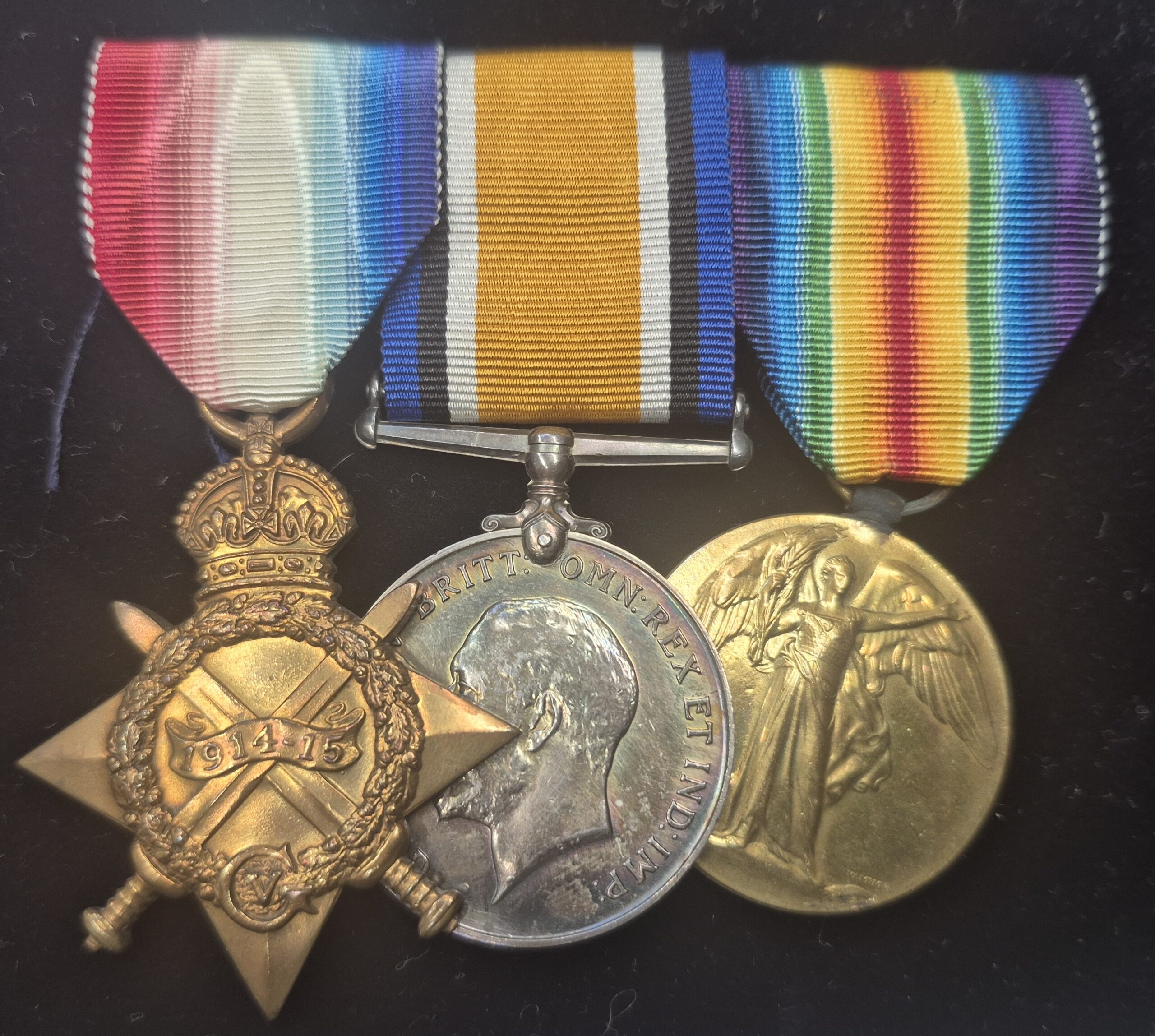
In 1908, William senior enlisted with The Royal Irish Regiment and served throughout The Great War in France, disembarking on the 8 February 1915. He was later discharged on 24 April 1918, and his pension records indicate he had a gun shot wound to his left elbow, received during the Second Battle of Ypres, on 11 July 1915.
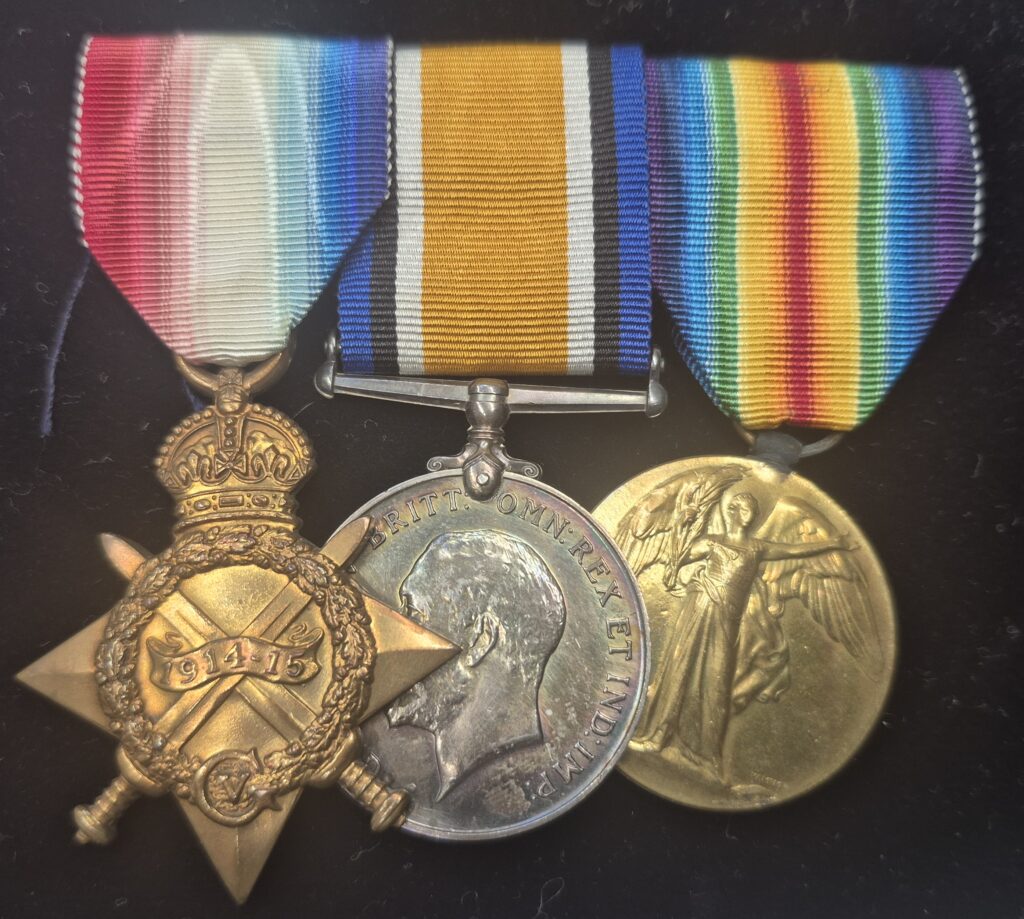
William’s wife Margaret Teresa (nee) Hairns, born Manchester, 1879, worked as a cook in the household of the lord lieutenant of Ireland. Kilkenny Castle, Kilkenny, Ireland.
Patrick Francis O’Mara or O’Meara (father), was the youngest of three, born- 3 January 1910, at Cemetery Cottage, next to the new council cemetery, Rossenarra, Kilmaganny, Kilkenny. he first attended Kilmaganny National School, then the Christian brothers- Callan, Kilkenny.
At age 18, Patrick found employment in the grocery and hardware trade, as an apprentice. Receiving no pay, but free accommodation and food. Working thirteen hours a day, it was pure slavery, receiving but a small pittance in return.
November 7 1928, Patrick left his employer without notice, due to being dissatisfied. Made his way to Northern Ireland, where he enlisted in the British army. Here he was issued with a travel warrant, to take him to Londonderry and on to England.
Arriving at the guards depot at Canterbury. He then enlisted in the 1st Battalion, Irish Guards on November 8 1928, with the service number 2716878; subsequently posted to Regimental Headquarters, Wellington Barracks, Birdcage Walk, London.
Because of low pay and having weekends free of duties, Patrick took on part time work as a stage extra at the Covent Garden Opera House. Seat capacity 2,256. He had parts in Tannhäuser and Lohengrin, mostly dressed up in the uniforms of the part.
He also performed at the Victoria Palace, Seat capacity 1,500, as an extra. On one occasion a part in The Chocolate Soldier, with Jack Hulbert (1882-1978) and Cicely Courtneidge (1893-1980).
Extra income enabled him to improve his education, by attending the London Polytechnic and institutes, offered by the London County Council.
Patrick met his future wife on Horse Guards Parade on Saturday June 4 1932 at about 1100 hrs. This was on the occasion of Trooping of the Colour, which involved the the 1st Battalion Irish Guards, 3rd Battalion Coldstream Guards, 2nd Battalion Scots Guards, 2nd Battalion Grenadier Guards. Patrick was at the time was handing out leaflets by the Guards monument.
Patrick was promoted and paid as a Lance Corporal as from August 24 1932, and a full Corporal from August 9 1933. By March 26 1932, he is a Lance Sergeant.
Three years later, he has is discharged from the army, on May 6 1935. He then enlisted in the Leicestershire Police Force, May 7 1935, but remained on the army reserve. Posted first to Loughborough, later to Kibworth-Beauchamp, followed by Market Harborough in 1939. Mum and dad were married February 12 1938.
Late 1939, army reserve call up is issued and dad reported to Divisional Headquarters, Market Harborough.
Back with the Irish Guards, Patrick was with the 2nd Battalion holding a rank of Lance Sergeant. His first deployment was “Operation Harpoon Force”, BEF.,12 May 1940 -15 May 1940.;the evacuation of Queen Wilhelmina and the Dutch government to England. He would have been on board of one of the following: SS Canterbury, SS Maid of Orleans, HMS Malcolm, HMS Whitshed.
His service during World War Two is then as follows:
Dunkirk, 22 May 1940- 24 May 1940. BEF. The evacuation of Dunkirk, assisting the Welsh Guards from Boulogne, France. Promoted to the rank of acting Sergeant. Travelled on one of the following ships: HMS Whitshed, Queen of the Channel, Mona’s Star.
August 25 1940, granted the rank of War Substantive Sergeant.
January 31 1941, posted to a training unit, locality unknown.
August 23 1942, posted to the 202nd officer cadet training unit Sandhurst. Moving to B Company on December 12 1942. This would have been at Southend on Sea, and the battle school near Snowdon, South Wales.
December 18 1942. Discharged having been appointed a commission.
December 19 1942. Appointed to an emergency commission in the Royal Army Service Corps with the rank of 2nd Lieutenant.
December 28 1942. Posted to Number 1 Holding Battalion, Leeds, Yorkshire.
“Operation Torch”. Sometime later, arriving at Glasgow docks, boarding an ex passenger ship, now a troopship. Possibly SS Strathmore of 23,500 grt, as the other troopship, the SS Strathallan was torpedoed previously on the December 21 1942.
April 10 1942. Patrick arrives in Algiers, and immediately posted to Number 42 Base Supply Depot. Royal Army Service Corps (1st Army).
From now on, little is known, only that Patrick mentioned that he was often in the desert, and in total darkness. Alone with a 38 Smith and Wesson revolver in hand, fearing a knife in the back, as ‘none of the Arabs could be trusted’.
Patrick’s first flying experience was with possibly 17 Squadron of the South African Air Force based at Bone airfield (Bone-les-Salines). He was given the role of rear gunner of a Ventura, GR, V bomber. Flying over the Algerian Saharien Atlas mountains. Peaks as high as 2236m. The reason for the flight is unknown.
May 16 1943. Patrick was at the victory parade held in the city of Tunis. Together with General Alexander, with whom he found to be a likeable fellow (quote).
Posted to a location between Sousse and Sfax. The site of a number of temporary POW camps, housing both German and Italian prisoners of war. Part of his duty was the interigation of prisoners.
‘The Germans made an everlasting impression on me, being smart, clean in appearance, shaved and dressed smartly, together with boots polished, as conditions allowed. Most noticeable, a respect for NCO’s. The Italians, some being somewhat lax in appearance, together with personal hygiene.’
Patrick was only in North Africa for approximately five months, before being posted to Bari in the foot of Italy.
October 17 1943. Posted to Number 71 Training company. Corps of Military Police, location unknown.
December 7 1943. Posted to Number 5 Battalion, GR, Training Depot, location unknown.
July 6 1944. Posted to Number 53 Base Supply Depot, Royal Army Service Corps.
November 30 1944. Posted to Number 429, General Transport Company, Royal Army Service Corps.
Patrick’s second flying experience, date and destination unknown. Flew in a US C-47 over the Alps, frozen to the bone, with only a couple of blankets to keep warm. While the aircrew were dressed in warm flying suits, and smoking cigars.
On October 10 1945, Patrick was informed that he would be returning to England and released.
Patrick’s third flying experience.Travelled by road to a transit camp, just south of Naples. Later flying out in a modified Avro Lancaster bomber. Eventually landing at an unknown RAF airfield in England.
Travelled by train to Market Harborough in full Officers uniform and kitbag, and met by wife and son.
Later reporting to the demobilisation centre, where uniform and kit was handed in. In exchange, received a demob suit of his own choosing, which was not liked, the opinion of many returning servicemen.
January 9 1946, Patrick was placed on the supplementary Reserve. He was in total three years away from home.
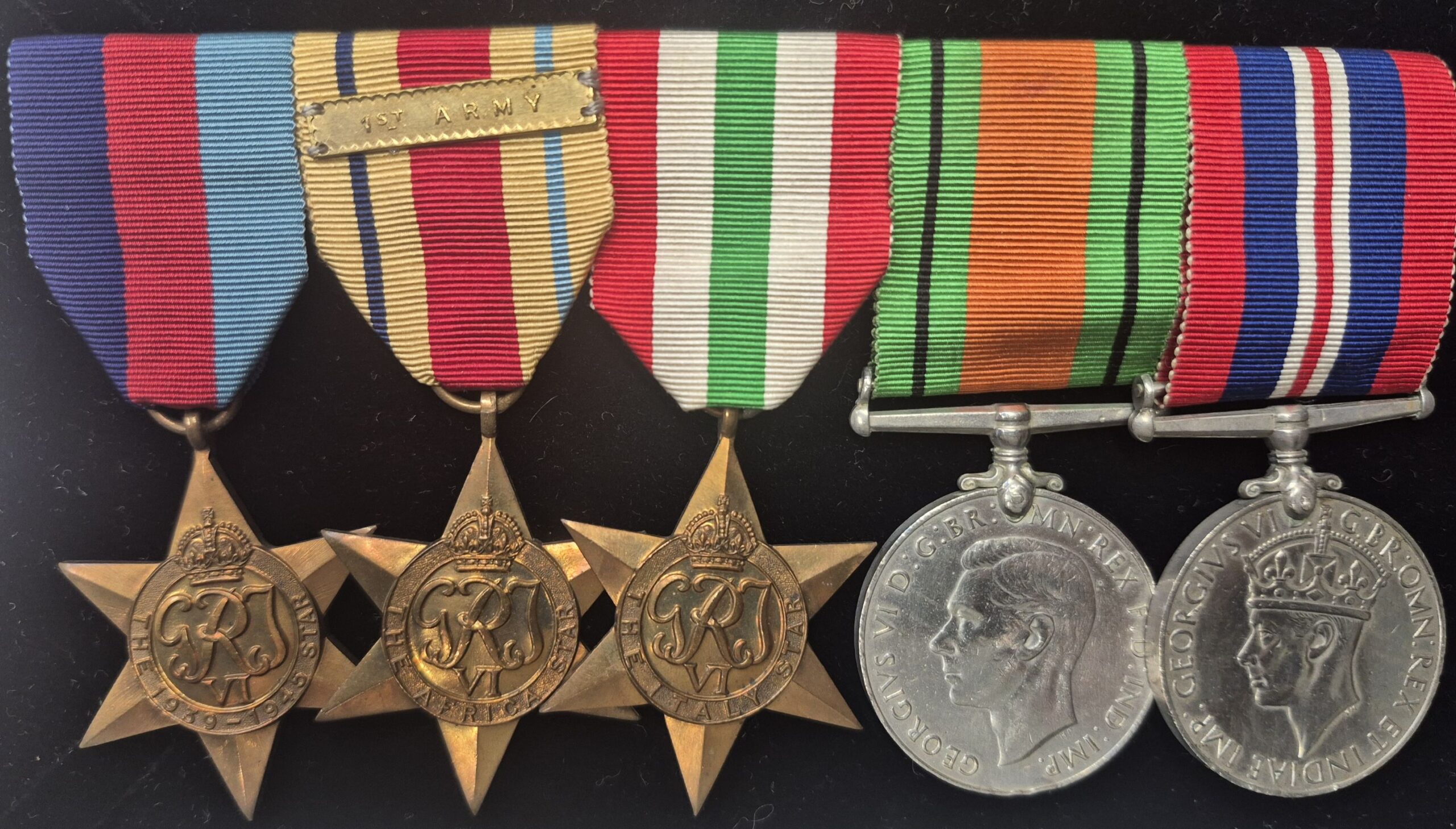
Patrick was awarded the 1939/45 Star, Africa Star, with First army clasp, Italy Star, Defence Medal 1939/45.
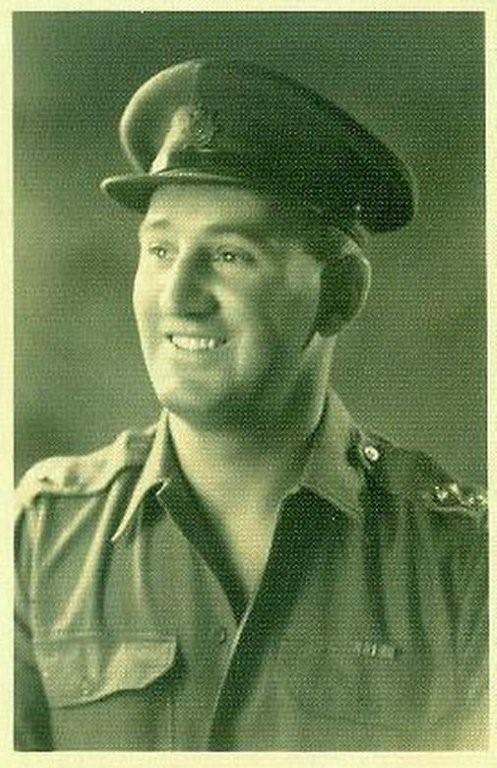
October 22 1946. Received a regular short service commission, with postings to Germany. Retired from the army in 1953, with the honorary rank of Captain.
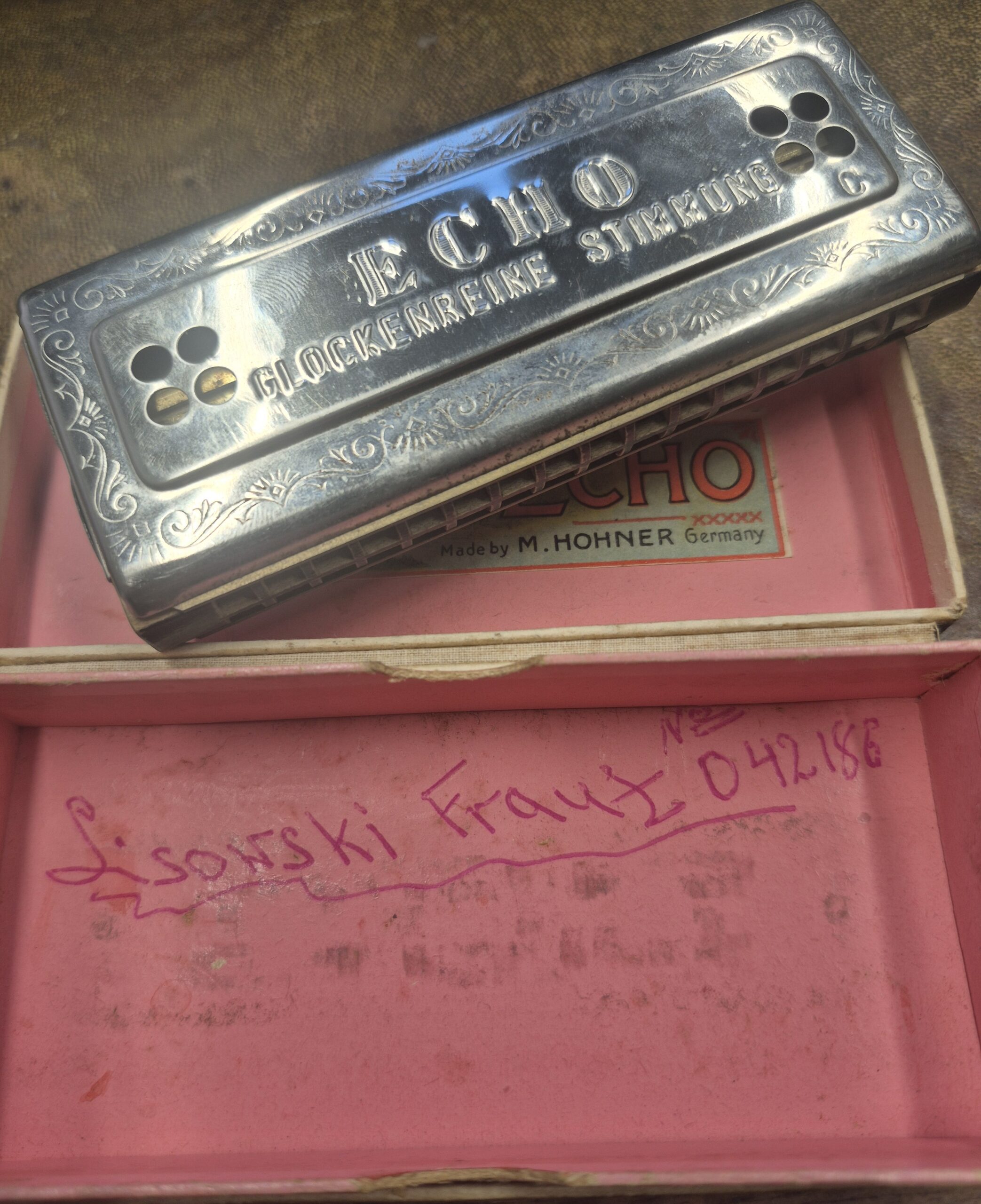
It is lovely to have dad’s medals, but we also have a lovely harmonica gifted to him by his batman, Franz. They kept in touch after the war.
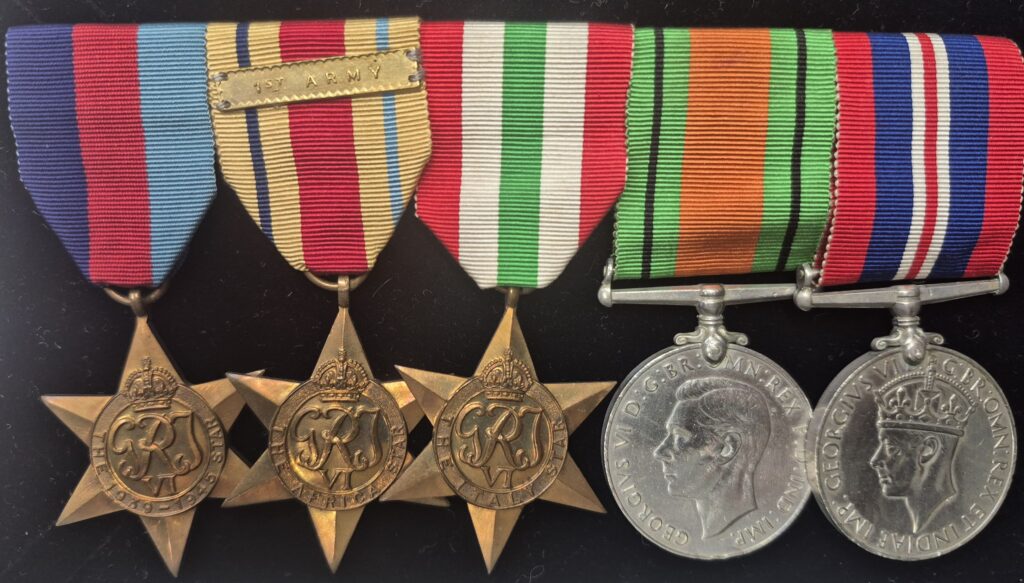
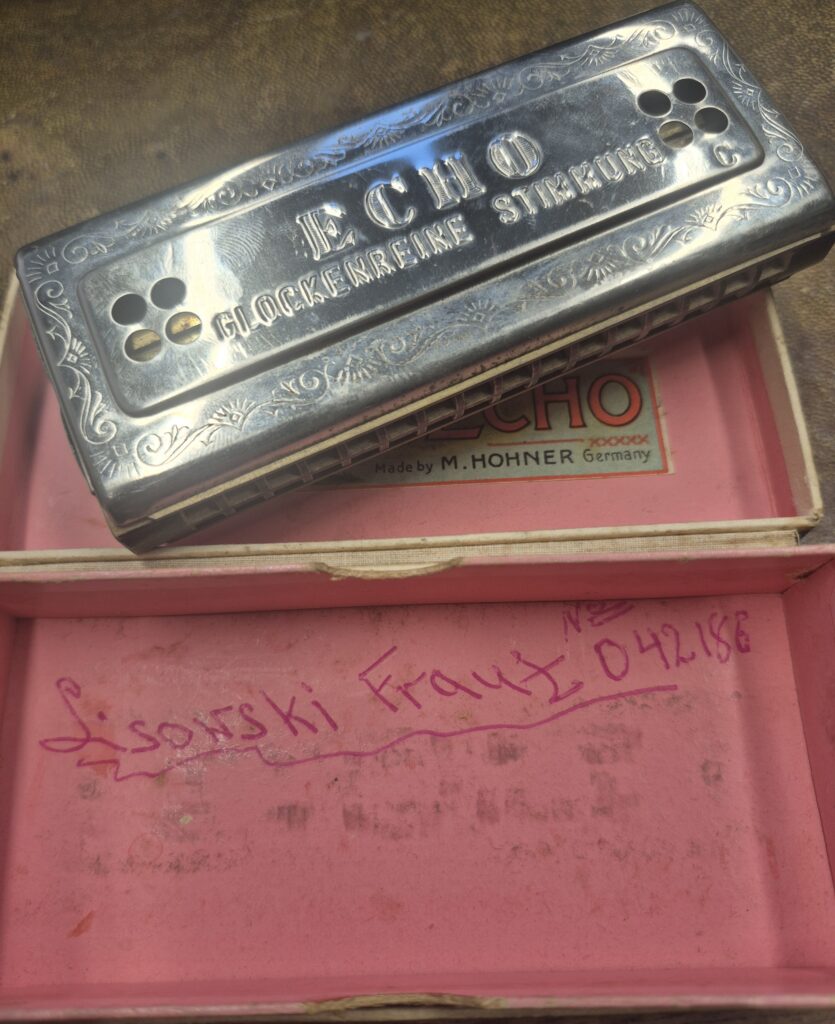
Photo gallery